Battery storage in practice

Review of the panel discussion at the Wind Energy Days in Potsdam on November 13, 2025

The demand for battery storage is increasing rapidly. They are the central flexibility instrument in an energy system characterized by volatile generation. But how can storage projects in Germany be developed, approved, implemented and operated efficiently and economically? These were the central questions of the panel discussion at the Wind Energy Days in Potsdam – with experts from MVV Trading, JUWI and AXSOL.

The crowded room clearly showed: The market is looking for answers. And it needs them urgently.

The bottleneck: Grid connection as a critical success factor

One of the clearest statements of the panel: The biggest hurdle is and remains the grid operator.

While the approval authorities work cooperatively in many cases, grid connection processes are often slow or end with restrictions – especially for standalone storage systems that want to draw from and feed into the grid.

“The biggest hurdle in project development is clearly the grid connection. Co-location and hybrid approaches get connected to the grid much faster because they have the least affect on the grid.”

Felix Beyer (AXSOL GmbH)

Co-location and hybrid projects are clearly at an advantage.
They use existing grid infrastructure and reduce the grid load. Storage systems that exclusively feed in (green electricity storage) receive commitments comparatively faster, while gray electricity storage systems with bidirectional operation often encounter more skepticism.

Another trend:
Many grid operators are already demanding documentation ready for planning with the connection request – noise reports, lease agreements or layouts. This is intended to weed out non-viable projects early on. Good preparation significantly shortens the waiting time.

Location selection and dimensioning: The grid logic determines the project size

It became clear in the panel: Storage systems are not dimensioned theoretically, but grid-driven.

Overbuilding is allowed and makes sense.
Hybrid PV or wind farms can now be supplemented with battery capacities that are significantly higher than the nominal output of the generation plant. The reduced revenues due to grid bottlenecks are moderate:

  • PV + storage: about 6 to 8 percent
  • Wind + storage: about 10 to 17 percent


Profitability benchmarks from the panel:

  • Green electricity storage: approx. 100,000 euros per MW per year
  • Gray electricity storage: approx. 280,000 euros per MW per year
    (Basis: market years 2024/25)


This difference shows the value that storage systems with grid access can develop. However, this requires clean grid, measurement and control logic.

Approval: Complex, but manageable

Although the grid connection is the biggest hurdle, approvals are also challenging.
Relevant points:

  • Noise
  • Fire protection
  • Water law
  • Clearance distances
  • Access road and transport logistics


A possible future simplification could be the privileging of storage systems in the outer area discussed in the EnWG. If it were decided, it would be a real accelerator.

Realization: The actual construction phase is not the problem

A surprising point from the discussion:
The physical realization of a storage system is comparatively uncomplicated – especially compared to wind or PV plants.

The challenges lie elsewhere:

  • Delivery times for switchgear: 30 to 45 weeks
  • Container delivery time: 6 to 9 months
  • Transfer stations: biggest time waster
  • Total project duration: 18 to 24 months


The core message of the experts:
Early, parallel work is crucial. This includes discussions with the grid operator, marketer, EMS partner and testing organizations. Projects that involve all stakeholders late lose valuable months.

Integration: Why storage systems are not plug-and-play technology

It became clear in the discussion:
Storage systems differ fundamentally from other generation plants.
They are dynamic systems that react daily to price signals, grid requirements and control energy.

“Battery storage is not plug-and-play. Every co-location project is custom-made. The system only works reliably in the end if everyone involved is at the table early on.”

Vivien Klein-Campailla (MVV Trading GmbH)

Each project is a tailor-made manufacture:

  • Individual interfaces between BMS, PCS, EMS and EZA control
  • Different grid protection logics
  • Marketer requirements
  • Communication protocols
  • Controller architectures

Standardization is only emerging, it is not yet established on the market.

Therefore: Have marketers, EMS providers and EPC plan together early on.

AXSOL was able to provide insights in this area into how an integrated EMS (AXOS) can standardize interfaces and what role AI-based optimization (ADONYS) plays in operation.

Operation: Where profitability is gained or lost

Storage systems only generate revenue when they are available.
There is hardly any fault tolerance.

Target values in the market:
Availability between 95 and 97 percent.

This requires:

  • Spare parts availability within 24 hours
  • Structured escalation chains
  • Precise degradation management
  • Intelligent cycle strategy


It was emphasized that marketing and technical operation are closely interlinked.
A marketer can plan the best schedules – if a module fails, it needs quick communication and technical solutions.

“The revenues of a storage system only arise with high availability. Everything stands and falls with clean integration, fast response times and a well-thought-out service and fault management.”

Leon Jacob (AXSOL GmbH)

The discussion highlighted how important it is to plan cycles flexibly over the years.
A typical storage system today runs about two cycles per day, in extreme cases more.
But the decisive factor is the service life strategy, which must take manufacturer and marketer logic into account.

Marketing models: More variety, more options

The market is developing different remuneration models for storage operators.
Three models dominate:

  1. Profit Share / Fully Merchant
    Maximum opportunities, maximum risk.
  2. Profit Share with Minimum Guarantee (Floor)
    Stable planning with reduced volatility.
  3. Tolling model
    Fixed remuneration per MW per year, typical values: from around 118,000 euros.

This is particularly interesting for project developers with an investor background – plannability enables financing security.

Conclusion: Storage systems are system projects – not individual products

The central finding of the panel can be summarized in one sentence:

Successful storage projects only arise when technology, regulation, marketing and operation are considered together from the outset.

Battery storage systems are not isolated systems.
They are the interface between market, grid and generation.
Projects that take this perspective and support stakeholders early on will be realized faster, cause fewer risks and generate significantly higher revenues.

The industry is at the beginning of a massive scaling.

With the right setup, storage systems can play a key role in the future energy infrastructure – flexible, economical and safe.

Watch the complete discussion now and delve deeper into the current developments in the BESS market.

Large-scale battery storage in Celle

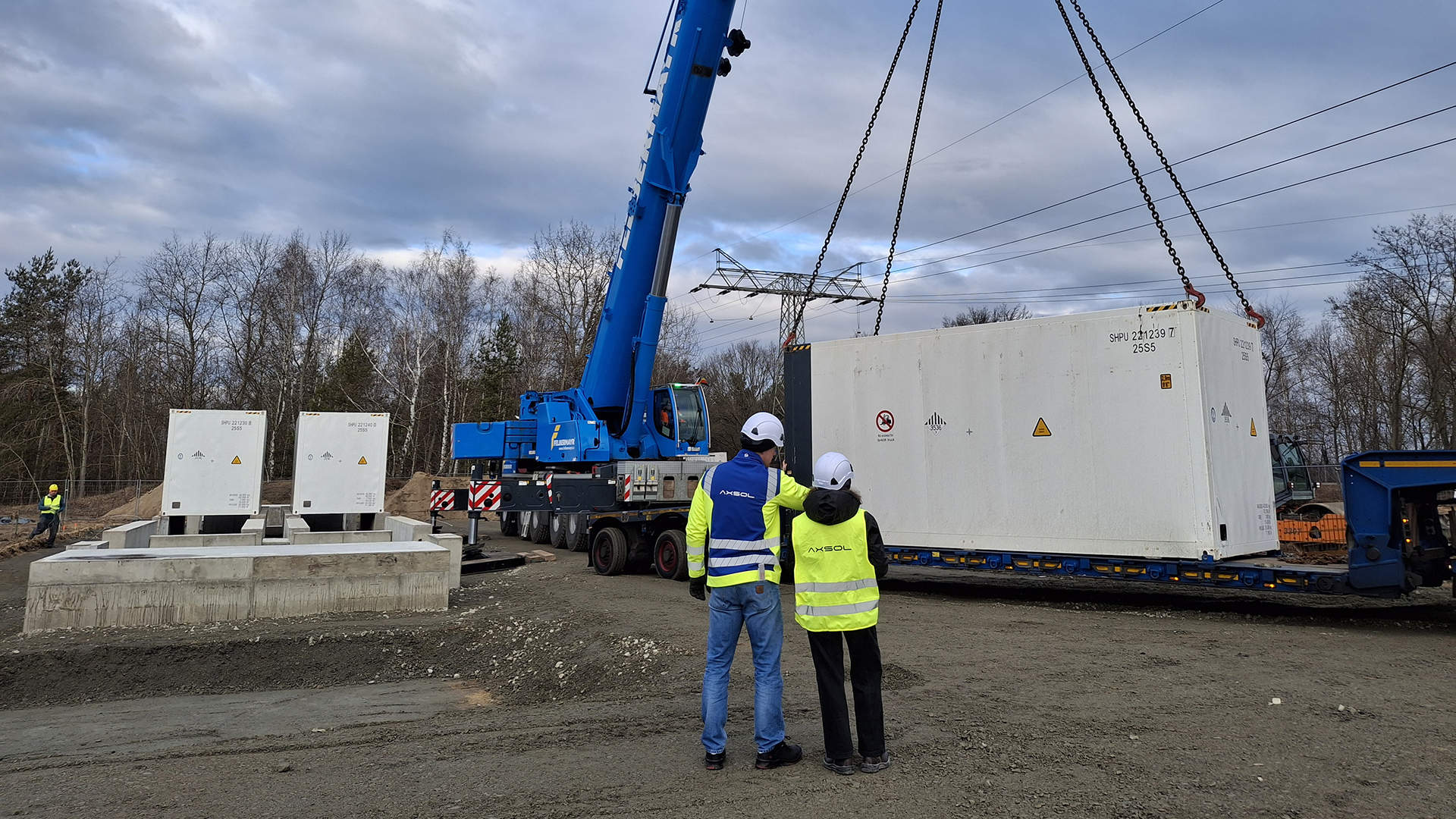
The energy transition brings with it a multitude of challenges, particularly in the areas of grid stability and security of supply. Renewable energies such as wind and solar provide sustainable electricity, but their fluctuating feed-in regularly presents grid operators with major challenges and causes strong fluctuations in our electricity prices. This is precisely where AXSOL and its project partner terralayr come in with their new battery storage project in Celle: With a capacity of 15 MW and a storage capacity of 30 MWh, Lower Saxony’s second-largest battery storage system will be built by the end of 2025.

This battery storage system will play a crucial role in ensuring a stable and future-proof energy supply by compensating for short-term load peaks, reducing frequency fluctuations, and enabling the optimal and cost-efficient use of renewable energies through energy trading. The heart of the system is the innovative AXOS energy management system, which guarantees maximum efficiency and economy thanks to AI-supported control. This project not only underscores AXSOL’s technological leadership, but also demonstrates how intelligent storage technologies can make a significant contribution to making Germany’s power grids fit for a sustainable future.

The project in Celle – A milestone for the energy supply

In Celle, Lower Saxony, a pioneering battery storage project is being built by the end of 2025, which is of great importance for the region and beyond. With a planned capacity of 15 MW and a storage capacity of 30 MWh, this project will be the second-largest battery storage system in the state. The project is representative of the increasing use of innovative storage technologies, which are essential for the energy transition.

AXSOL is assuming full responsibility for this project, from the planning and implementation of the construction measures to the delivery, installation and commissioning of the large-scale battery storage system (EPC). By selecting state-of-the-art components and its intelligent EMS AXOS, AXSOL guarantees a long-term and secure investment. The battery storage system will not only be an important component for grid stabilization, but will also serve as a reference for future projects that focus on sustainable and intelligent energy storage.

Grid stability through advanced energy management

The increasing integration of renewable energies poses complex challenges for grid operators. Solar and wind energy naturally do not supply electricity constantly, which can lead to fluctuations in the power grid. These so-called frequency fluctuations endanger the stability of the power supply and, in the worst case, can even lead to failures.

The project in Celle addresses precisely this challenge: By installing an ultra-modern battery storage system, controlled by AXSOL’s intelligent AXOS energy management system, these fluctuations are efficiently compensated for. The system smooths short-term load peaks, reduces frequency fluctuations in real time and ensures optimized use of renewable energies.

Particularly noteworthy is the advanced control provided by AXOS, which guarantees adaptive, flexible and economical operation thanks to artificial intelligence (AI). The core functions include:

  • Real-time analysis for precise adjustment of the charging and discharging cycles to the current demand.
  • Automated optimization of performance and economy through intelligent algorithms.

By choosing this innovative approach, AXSOL is not only setting technological standards, but is also making a significant contribution to a sustainable, stable and economically attractive energy supply for the future.

Technological excellence: Battery storage with LFP technology

AXSOL is using state-of-the-art lithium iron phosphate batteries (LFP) for the implementation of the project in Celle, which have been specially optimized for use in stationary storage systems. This battery technology is currently the preferred choice for large-scale storage projects, especially when high safety requirements and long-term reliability are required.

The advantages of LFP batteries speak for themselves:

  • Highest safety standards:
    The LFP cells used are characterized by particularly high thermal stability. They offer a minimized risk of fires or explosions, which has been confirmed by intensive safety tests (such as nail penetration and crush tests).
  • Longevity and economy:
    With a service life of over 103,000 charging cycles, the batteries guarantee long-term performance and thus significantly reduce the total costs over the service life (LCOS – Levelized Cost of Storage). This high cycle stability makes them a particularly economical solution.
  • Flexible and versatile use:
    The batteries can be ideally adapted to various applications – whether for grid stabilization, peak shaving or for the integration of renewable energies. Their compatibility with the AXOS energy management system ensures seamless and optimized operational control.

Through this combination of safety, longevity and flexibility, AXSOL offers its customers maximum investment security and a future-proof technology that operates economically efficiently and meets the highest regulatory requirements.

Partnership for innovative energy storage solutions

A project of this magnitude and technological complexity is best achieved through strong partnerships. AXSOL is realizing the battery storage system in Celle together with terralayr, a company that specializes in innovative marketing concepts for battery storage systems.

The collaboration with terralayr offers a number of key advantages:

  • Digital networking via a cloud-based platform:
    The intelligent networking of battery storage systems enables terralayr to optimally control and market stored energy. This leads to maximum economic and grid-serving flexibility, from which both operators and users benefit.
  • Optimized economy and efficiency:
    Terralayr’s approach makes it possible to flexibly offer surplus storage capacities on the energy market. This creates additional sources of revenue for operators and municipal utilities, which significantly improves the economy of the battery storage system.

This innovative form of cooperation shows how modern technologies and intelligent marketing concepts together contribute to using battery storage not only as a technical component, but also as an economically lucrative solution in the context of the energy transition.

The successful partnership between AXSOL and terralayr in the Celle project once again underscores the value of shared expertise and creates a trend-setting reference for future projects that want to meet the challenges of the energy transition with economically and technologically strong solutions.

AXSOL as EPC partner for sustainable energy projects

Complex projects such as the battery storage system in Celle require not only technological expertise, but above all experience in the area of project management. This is precisely where another strength of AXSOL lies: The company acts as an EPC partner (Engineering, Procurement and Construction) and thus offers all project steps – from planning to installation and commissioning – from a single source.

The advantages of this EPC strategy for customers and partners are compelling:

  • Turnkey solutions (one-stop shop):
    AXSOL covers the entire EPC process – from technical and commercial planning to dimensioning and integration, right through to the complete installation (including construction services) and handover of the finished system. Customers thus receive a reliable partner for the entire duration of the project.
  • Modular and scalable systems:
    With its modular ECS approach, AXSOL can flexibly and individually configure battery storage systems from 3 MWh. This enables precise adaptation to different project requirements and linear scalability, which in turn guarantees high economy and future security.
  • Proven expertise in large-scale battery storage solutions:
    Thanks to extensive experience in large-scale projects – particularly in the area of grid-connected industrial storage – AXSOL offers its partners maximum security in the implementation of technologically demanding projects.
  • Comprehensive service and maintenance:
    Beyond commissioning, AXSOL ensures long-term reliability through proactive maintenance, 24-hour support and customized warranty packages. Efficient spare parts management and fast response times also ensure minimal downtimes and maximum availability.

Through its role as an experienced EPC partner, AXSOL makes a significant contribution to the successful implementation of sustainable and technologically sophisticated energy projects. The project in Celle is an example of this approach and is a pioneering example of intelligent, reliable and economically viable battery storage solutions.

About AXSOL – Future-oriented energy storage solutions

AXSOL has stood for intelligent and modular battery storage systems for years, accompanying the entire process of sustainable energy use – from the initial consultation and planning to installation and efficient operation. Based in Würzburg, AXSOL specializes in developing innovative solutions that optimally support industrial companies, energy suppliers, plant operators and operators of critical infrastructures in reducing their energy costs and ensuring grid stability.

AXSOL’s core competencies include:

  • Intelligent energy management:
    The heart of all AXSOL solutions is the innovative AXOS energy management system, which guarantees both the highest technical standards in data security and optimal market integration thanks to AI-supported control.
  • Comprehensive full-service approach:
    Customers benefit from the fact that planning, installation, operation and maintenance are offered from a single source – a holistic service that ensures maximum reliability and minimal project risks.
  • Sustainable and safe technologies:
    In terms of technology, AXSOL consistently relies on future-proof lithium iron phosphate batteries (LFP), SF6-free switchgear and intelligent liquid cooling to ensure maximum safety, longevity and economy.
  • Proven experience and innovative strength:
    AXSOL brings many years of experience from demanding projects in the area of critical infrastructures and has already received several awards – including the German Innovation Award and inclusion in the top 10 lists of European defense and energy tech providers.

With the project in Celle, AXSOL is once again setting standards and positioning itself as a leading provider of battery storage technology in Germany. The company’s vision of actively shaping the energy transition with innovative and intelligent storage systems is impressively put into practice here.

Conclusion – Battery storage as a key technology for the energy transition

AXSOL’s battery storage project in Celle impressively demonstrates how innovative energy storage solutions contribute to securing grid stability while at the same time opening up economically attractive opportunities. Through intelligent control, state-of-the-art technologies such as LFP batteries and proven expertise in project management, AXSOL offers sustainable and future-proof solutions that are essential for the energy transition.

Especially in view of growing challenges such as increasing electricity demand and volatile renewable energy sources, such battery storage systems are becoming indispensable components of modern energy infrastructures. Projects such as the one in Celle are therefore not only technologically groundbreaking, but also economically and socially relevant – they form the basis of a secure and sustainable energy future.

Now it’s your turn!

Are you also interested in sustainable battery storage solutions or would you like to learn more about innovative energy management systems?

We look forward to your feedback and exchange!

Battery storage in Lohsa

Another milestone for flexible energy systems: Together with terralayr AG, AXSOL is realizing a state-of-the-art battery storage system for grid support in Lohsa, Saxony. The 8 MW / 16 MWh storage system will provide primary control power from spring 2026 and specifically relieve the local power grid.

Storage intelligence that strengthens the grid

In an increasingly decentralized and volatile energy system, new forms of flexibility are needed. This is precisely where the project in Lohsa comes in: The system planned by AXSOL will smooth load peaks, balance volatile feed-in, and provide control power in real time – controlled by the intelligent energy management system AXOS.

AXOS permanently analyzes grid states, forecasts energy flows, and dynamically controls the storage system according to market and grid requirements – AI-supported, automated, and highly available. For operators like terralayr, this creates maximum economic efficiency with minimal effort.

“With AXOS, we are turning storage systems into active grid elements. The project in Lohsa shows how modern technology is locally securing the energy transition,” says Jürgen Zinecker, Managing Director of AXSOL.

Technology that pays off

The heart of the storage system consists of particularly durable LFP cells with over 10,000 charging cycles. The container solutions feature integrated liquid cooling, a precise battery management system (BMS), and certified safety mechanisms – developed for maximum operational safety, minimal maintenance costs, and highest performance.

Advantages for operators:

  • Lowest operating costs through automated management and high system availability
  • Scalability and modularity through the ECS architecture from AXSOL
  • Maximum investment security through comprehensive guarantees on performance, capacity, and availability guarantee

AXSOL – Your EPC partner for grid-scale storage solutions

From project planning and procurement to construction and commissioning: AXSOL takes over all EPC services (Engineering, Procurement, Construction) and brings many years of experience in grid-connected large-scale storage systems – including system integration, safety concepts, and grid connection unique selling points.

The project in Lohsa is not an isolated example: As part of the Joachim Loh Group, AXSOL offers stable partnerships for customers from energy supply, industry, and critical infrastructure company profile.

Together towards the future

terralayr operates a cloud-based platform for the aggregation of storage systems for system services and arbitrage. In combination with AXOS, a powerful overall system is created – digital, flexible, future-proof.

Conclusion

Projects like Lohsa show how technological excellence and digital control are specifically implementing the energy transition at the grid level. With AXSOL as an EPC partner and AXOS as an intelligent control center, energy suppliers and storage aggregators are creating a stable foundation for a flexible, CO₂-neutral energy system.

Are Battery Storage Systems Dangerous?

Battery storage systems play a central role in the energy transition – they enable the efficient use of renewable energies, reduce energy costs, and stabilize the power grid. However, doubts and concerns repeatedly circulate: Are battery storage systems dangerous? In this article, we will examine in detail the safety aspects of modern battery storage systems, address common myths and risks, and show how innovative solutions overcome these challenges.

The discussion surrounding the safety of battery storage systems is not new. With the rapid expansion of renewable energies and the increasing use of energy storage systems in industry, utility sectors, and even electromobility, interest in robust, safe, and sustainable technologies is growing. But what truly lies behind the headlines about fire risks and technical defects?

In this article, you will learn what battery storage systems are, what risks may exist, and, most importantly, how modern safety technology and concepts minimize these risks. We will also highlight the advantages that battery storage systems offer – when properly designed and maintained – and provide an outlook on future developments. Let us delve into the world of battery storage systems together and separate myths from facts.

What are Battery Storage Systems?

Battery storage systems are energy storage systems that store electrical energy in chemical form and release it when needed. These systems are found in almost all areas of the energy industry – from private households and industrial applications to large-scale grid stability solutions.

Key Functions of Battery Storage Systems:

  • Self-consumption optimization: It enables you to use self-generated energy in the most efficient way, reducing overall energy costs.
  • Peak Shaving: By reducing peak loads, the strain on the power grid is significantly lowered.
  • Emergency power supply: In critical situations, they ensure a reliable energy supply for essential infrastructure.
  • Integration of renewable energy: They help balance fluctuations in power generation from wind and solar sources.
  • Flexibility marketing: They store energy when there is a surplus in the grid and release it again as soon as it is needed at a later time.
  • System services: They support the stabilization of the power grid through frequency regulation

Companies like AXSOL are now applying the battery expertise acquired over 12 years in the defense sector to the civilian domain, offering modular and scalable solutions – secure battery systems for commercial and residential areas, up to large-scale storage for utilities, grids, and industry – that can be flexibly adapted to the needs of various applications. These systems are characterized not only by their efficiency but also by comprehensive safety mechanisms that minimize the risk of potential hazards.

Safety Aspects of Battery Storage Systems

Technical Safety and Fire Protection

Modern battery storage systems are developed and tested under strict safety standards. Numerous technical measures are employed to prevent potential risks such as overheating, short circuits, or even fires:

  • Liquid cooling/heating as the safest and most effective variant for temperature control of battery cells.
  • Intrinsically safe cell chemistry with high capacity – lithium iron phosphate cannot self-ignite.
  • Integrated Sensor Technology: Temperature and voltage sensors monitor the condition of battery cells in real time.
  • Active Thermal Management: Cooling systems and heat dissipation concepts ensure that the batteries do not overheat.
  • Robust Housings: High-strength materials and secure sub-constructions minimize the risk of mechanical damage.
  • Fire Protection Systems: Modern fire protection and extinguishing systems are an integral part of many storage solutions and react automatically in an emergency.

These technical safety aspects form the basis for battery storage systems offering far more opportunities than risks in practice.

Safety through Intelligent Systems

The integration of modern information and communication technologies has further increased the safety of battery storage systems. AI-supported energy management systems, such as those used by AXSOL, not only optimize energy flow but also contribute to the prevention of malfunctions:

  • Early Warning Systems: Through continuous data analysis, potential malfunctions are detected and rectified early.
  • Load Distribution: Intelligent control systems regulate power flow and prevent sudden overloads.
  • Remote Monitoring: Operators can monitor their systems in real time and react immediately to irregularities.

Thanks to these advanced technologies, the risk of an uncontrolled failure is significantly reduced – a crucial factor for the safe operation of battery storage systems.

Experience and Certifications

Numerous projects and test series demonstrate that battery storage systems can be operated safely in compliance with applicable norms and standards. Companies like AXSOL, which have been repeatedly recognized for their innovations (for example, with the Federal Innovation Award and awards in the fields of Defense and Energy Storage), rely on certified components and continuous quality controls. These experiences and certifications provide both businesses and end-users with the necessary assurance that modern storage systems operate reliably.

Common Concerns and Risks

In discussions about battery storage systems, various concerns repeatedly circulate. Here are the most common points at a glance:

  • Fire Risk:
    There is concern that improper handling or material defects can lead to fires. Modern systems, however, feature integrated fire protection measures and active cooling systems that drastically minimize the risk.
  • Thermal Runaway:
    The so-called “thermal runaway” describes a process in which a battery heats up uncontrollably. However, through precise temperature monitoring and automatic shutdown systems, this scenario is rare and only possible under extreme conditions.
  • Improper Installation and Maintenance:
    Many risks arise from faulty planning or insufficient maintenance. Professional providers offering a full-service solution from a single source – from planning and installation to regular maintenance – ensure that all safety aspects are observed.
  • Environmental and Disposal Issues:
    The disposal of batteries can also be problematic if not done in an environmentally sound manner. Here, manufacturers increasingly rely on recycling concepts and sustainable materials.

Conclusion on Risks:

The potential dangers of battery storage systems are primarily attributable to improper handling and outdated technology. Modern systems, however, offer a high degree of protection through comprehensive safety concepts and regular maintenance – thus, they are far from being considered mere fire hazards.

Modern Solutions and Safety Concepts

Manufacturers and service providers have made significant progress in recent years to continuously improve the safety of battery storage systems. Here are some of the most important measures:

  • Full-service from a single source:
    Continuous support from planning and installation to maintenance ensures that all components are optimally coordinated. This reduces sources of error and increases operational safety.
    Example: AXSOL offers individual support and long-term assistance, ensuring your storage solution is always state-of-the-art.
  • Modularity and Standardization:
    Modular systems allow battery storage to be flexibly adapted to specific needs. This not only enables optimal utilization of the storage but also targeted safety optimization for every application.
  • AI-supported Energy Management:
    Intelligent control and monitoring systems detect potential risks early and automatically initiate countermeasures. This increases not only the efficiency but also the safety of the overall system.
  • Investment Protection and Warranty:
    Many providers offer long warranty periods (e.g., 5 years), which underscores the value retention and reliability of the systems. A market-leading warranty offers additional confidence in the technology.
  • Plug & Play Solutions:
    Standardized interfaces and easy integration into existing energy systems facilitate installation while reducing the risk of installation errors.
  • Coordinated Fire Protection Concepts:
    Coordination of comprehensive fire protection concepts with local authorities and fire departments. Fire departments are also becoming more adept at handling battery storage systems.

These modern safety concepts show that battery storage systems are by no means to be considered dangerous components – on the contrary: with proper planning and support, they offer a reliable and future-proof solution for energy supply.

Advantages of Battery Storage Systems despite Alleged Dangers

Once the safety aspects are clarified, it becomes clear that battery storage systems offer numerous advantages that far outweigh their risks:

  • Maximum Energy Savings:
    By optimizing self-consumption and intelligently controlling energy flow, companies can significantly reduce their energy costs.
  • Grid Stability and Emergency Power Supply:
    Battery storage systems help to avoid peak loads and keep the power grid stable. In an emergency, they can ensure an uninterrupted power supply, which is of great importance, especially for critical infrastructures.
  • Environmentally Friendly Energy Use:
    Storing surplus renewable energy prevents waste and reduces the need for fossil fuels. This leads to a better CO₂ balance and supports climate protection.
  • Flexibility and Future-Proofing:
    Thanks to modular design and intelligent technologies, battery storage systems can grow with demand and adapt to changing requirements – a clear competitive advantage in dynamic markets.
    USP: “Modular & scalable” – future-proof and flexibly expandable.
  • Economic Advantages:
    Through the targeted use of battery storage systems, companies can generate additional revenue, for example, through the direct marketing of surplus energy.

Practical Example:
A large enterprise invested in a battery storage system to smooth its peak loads, thereby not only saving energy costs but also increasing its operational safety. Thanks to intelligent control and modular design, the system could be flexibly adapted to increasing energy demand – a successful example of the advantages of modern energy storage.

Myths and Facts: are Battery Storage Systems Dangerous?

In many discussions, myths circulate that portray battery storage systems as potential fire hazards or risky investments. A differentiated perspective helps to debunk these prejudices:

Myth 1: Battery Storage Systems are Fire Hazards

Fact:
Modern battery storage systems are equipped with extensive safety mechanisms. Through precise temperature controls, active cooling methods, and intelligent monitoring systems, the risk of fire with professional installation is virtually eliminated.

  • Fact Check: Studies and practical experience prove that the risk of fire in certified systems is minimal.

Myth 2: Technical Defects Inevitably Lead to Accidents

Fact:
Every technical system theoretically carries a residual risk – however, regular maintenance and qualified installations significantly minimize the risk. Furthermore, self-monitoring functions and remote maintenance systems are used, which react early to any malfunctions.

  • Fact Check: Companies like AXSOL offer a full-service approach that covers all phases of a battery storage system’s lifecycle to guarantee maximum safety.

Myth 3: Battery Storage Systems are just a Fad without Sustainable Benefit

Fact:
The integration of battery storage systems into energy systems not only enables the use of renewable energies but also leads to significant cost savings and a more stable grid supply. They are a central building block for a sustainable energy future and offer long-term economic advantages.

  • Fact Check: Many years of market experience and innovative projects, such as the lighthouse project for the Federal Office for Civil Protection and Disaster Assistance (BBK), underscore the real added value of this technology.

Summary of Myths and Facts:

  • Risk of improper use: Possible, but avoidable through professional planning and maintenance.
  • Technological Advancements: Modern systems are robust and offer extensive safety precautions.
  • Long-term Benefits: Battery storage systems are essential for the energy transition and offer numerous economic and ecological advantages.

Internal Tip: Also read our article “Safety in Battery Storage – Myths and Facts” to delve deeper into this topic.

Future Perspectives and Developments

Battery storage technology is evolving rapidly. Future innovations will not only increase efficiency and storage capacities but also further improve safety. Some trends and developments expected in the coming years are:

  • Further Development of Battery Technology:
    New battery types and materials are intended to increase energy density while simultaneously improving safety.
  • Improved Recycling Concepts:
    Sustainable recycling processes ensure environmentally sound disposal and reuse of materials.
  • Advanced Remote Monitoring and Diagnostic Systems:
    Through the use of Big Data and artificial intelligence, sources of error are detected and rectified even faster.
  • Integration into Smart Grids:
    Battery storage systems are increasingly integrated into intelligent grids, leading to even more efficient control of the entire energy system.
  • Increasing Investments in Research and Development:
    Both government funding programs and private investments drive innovation in energy storage.

These developments show that battery storage systems are not only safe but will also play an increasingly important role in the global energy transition.

Conclusion: are Battery Storage Systems Dangerous or an Opportunity?

The question of whether battery storage systems are dangerous cannot be answered unequivocally. As with any technology, the risk largely depends on the quality of the components, professional installation, and continuous maintenance. Modern systems, based on certified components, intelligent monitoring, and comprehensive safety concepts, minimize potential dangers almost completely.

Key Messages at a Glance:

  • Safety Through Technology and Service:
    Integrated sensor technology, active cooling systems, and full-service approaches guarantee safe operation.
  • Economic and Ecological Advantages:
    Battery storage systems reduce energy costs, stabilize the grid, and promote the use of renewable energies.
  • Future-Proof Technology:
    Thanks to modular design and continuous innovation, battery storage systems flexibly adapt to growing requirements.

In summary, battery storage systems – when properly deployed – offer far more opportunities than risks. They are a crucial building block for a sustainable and future-oriented energy supply and contribute significantly to the reduction of CO₂ emissions.